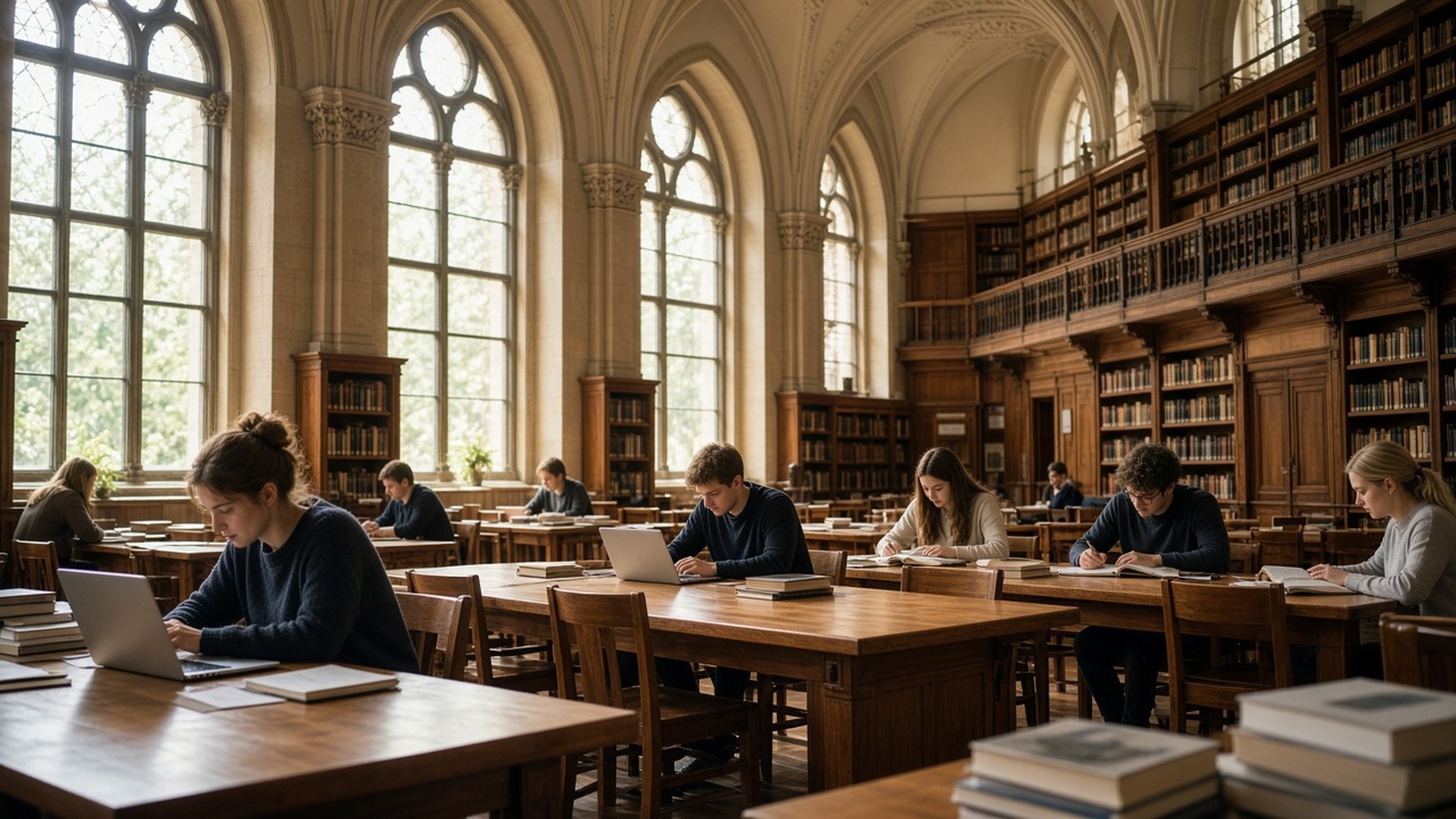
German libraries are bright, calm and often free or very cheap for students, and one famous university library never closes at all. Here is how Sri Lankan students can turn them into a study base, a reading room and even a place to borrow a drill.
When Sri Lankan students imagine life in Germany, they usually picture old town squares, train journeys and Christmas markets. Very few imagine a library. However, ask students who have lived in Germany for a year where they spend their best hours, and many will name one. German libraries are bright, warm in winter, quiet when you need to focus and surprisingly social when you need a break. Many of them are also free or very cheap for students.
So if you are planning to study in Germany, here is a friendly guide to the libraries that could soon become your second home.
Your university library is built for you
Every German university has at least one central library, and many faculties have their own smaller libraries as well. These are not dusty rooms with a few old books. They are modern study spaces with reading rooms, group study rooms, Wi-Fi, printers, scanners, lockers and long rows of desks with power sockets.
Some university libraries are truly impressive. The KIT Library South at the Karlsruhe Institute of Technology has been open 24 hours a day since 2006, which made it one of the first academic 24-hour libraries in Germany. It offers more than 950 individual and group workspaces, and some of them can be reserved in advance. In the evening and at weekends, students simply use their library card to open the door.
Not every library stays open around the clock, of course. Opening hours differ from university to university and often change during semester breaks, so always check your own library’s website. Still, long evening hours are common, especially during exam season.
One practical tip makes a big difference here. Look for the textbook collection, which German libraries often call the Lehrbuchsammlung. It holds several copies of the books your professors recommend most often, which means you may not need to buy expensive textbooks at all.
Your student card often opens the door
At many German universities, your student ID card also works as your library card. At others, you register once at the library desk or online. In both cases, borrowing books from your own university library is normally free for enrolled students.
This is worth remembering when you plan your budget. A good university library can replace a lot of spending, because you can borrow textbooks, read academic journals online through the university network and print or scan what you need for a small fee.
Your city library is a whole new world
Beyond your campus, almost every German city has a public library, called a Stadtbibliothek or Stadtbücherei. These libraries are made for everyone who lives in the city, so they offer novels, comics, films, music, games, newspapers, German learning materials and comfortable places to sit and read.
Many city libraries offer student discounts, and some are even free. For example, the Stadtbibliothek Stuttgart charges adults 24 euros a year. However, since 1 March 2026, school pupils, trainees and students up to the age of 26 can use it free of charge when they show proof of their status. In Berlin, the public library network VÖBB charges 10 euros a year for adults and 5 euros a year for students. Just keep in mind that in Berlin the student discount is only given when you register in person at a library, not online.
To get a card, you usually bring your passport together with your city registration certificate, which Germans call the Meldebescheinigung. Prices and rules differ from city to city and can change, so check your local library’s website before you go.
The Stuttgart city library is also one of the most photographed buildings in Germany. Its bright white interior, with floors of books arranged around an open central space, looks almost unreal. Visiting it on a quiet afternoon is a small adventure in itself.
A library in your pocket
One of the nicest surprises for new arrivals is the Onleihe. The name combines the words online and Ausleihe, which means lending. With a valid card from a participating public library, you can borrow e-books, audiobooks, digital newspapers and magazines through an app or a web browser, usually at no extra cost.
The best part is that digital loans return themselves. When the loan period ends, the file simply stops opening, so you never pay late fees for an e-book. At the Hamburg public libraries, for example, e-books and audiobooks can be borrowed for up to 21 days. Popular titles are sometimes already on loan, because libraries buy a limited number of licences. In that case, you just reserve the title and wait for your turn.
For a student who spends long hours on trains, this is wonderful. Your Deutschlandsemesterticket takes you across the region, and the Onleihe gives you something good to read or listen to on the way.
Borrow a drill, a guitar or a sewing machine
Some German libraries go far beyond books. The Stadtbibliothek Stuttgart, for example, runs a Bibliothek der Dinge, which means a library of things. There you can borrow objects such as musical instruments and other useful items for two months, for 2.50 euros per item.
This idea fits student life perfectly. When you move into a new room and need to hang a shelf, you rarely want to buy tools you will use only once. Not every city offers a library of things, and the items available differ from place to place, so ask your local library what it has.
The perfect place to learn German
Libraries are also one of the best free tools for learning German. Public libraries usually have a section for German as a foreign language, with graded readers, grammar books, audio courses and children’s books that are simple enough for beginners. Reading a short children’s book in German may feel funny at first, however it is one of the fastest ways to build everyday vocabulary.
Many libraries also host events such as reading clubs, language cafés or conversation groups. These are friendly places to practise German with real people, so look at the events calendar of your local library soon after you arrive.
A few library habits worth knowing
German libraries run smoothly because everyone follows a few simple habits. Here are the ones that will help you settle in quickly:
- Use the lockers. Many reading rooms do not allow large bags and coats, so you leave them in a locker near the entrance. A one-euro coin is sometimes needed for the lock.
- Respect the quiet zones. Reading rooms are for silent work, while group rooms and cafés are for talking. Phone calls belong outside.
- Eat in the right places. Food is usually not allowed in reading rooms, although a bottle of water is often fine.
- Return items on time. Late fees are small but they add up. In Berlin, for example, adults pay 25 cents per item for each day a loan is overdue.
- Arrive early in exam season. Seats in popular libraries fill up quickly before exams, so a morning start pays off.
More than a building
The real magic of a German library is not the books or the desks. It is the feeling of belonging. You sit next to students from every corner of the world, all working towards their own goals. You take a coffee break with a classmate and leave with a new friend. On a dark winter evening, you work in a warm, bright room instead of alone in your flat.
For many Sri Lankan students, the library becomes the place where hard work turns into good grades and where a new city slowly starts to feel like home. So when you arrive in Germany, make your library card one of the first things you collect.
Plan your study in Germany from Sri Lanka
Life in Germany starts with a good plan. These free Belfurt tools help you take the next step:
- Study in Germany Cost Calculator (LKR): estimate your blocked account, rent and monthly costs in rupees.
- Master’s Readiness Check: check your grades and profile for German master’s programmes.
- Visa Interview Simulator: practise typical German student visa interview questions.
Questions? Message Belfurt on WhatsApp at +94 77 056 9927 or use our contact page.