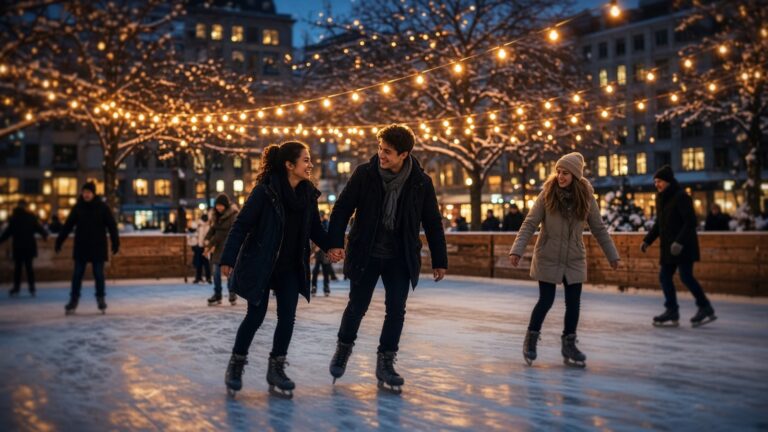
From late November, almost every German town lights up with wooden stalls, warm drinks and free evening fun. Here is how Sri Lankan students can enjoy their first Christmas market season on a student budget.
From late November, almost every German town lights up with wooden stalls, warm drinks and free evening fun. Here is how Sri Lankan students can enjoy their first Christmas market season on a student budget.
Many Sri Lankan students arrive in Germany expecting the winter to be the hard part. The days get short, the air turns cold and the sun sets before your last lecture ends. However, something surprising happens at the exact moment the weather turns grey. Town squares fill with small wooden huts, strings of warm lights and the smell of roasted almonds. The Christmas market season begins, and for many international students it becomes the happiest memory of their first year.
You do not need to be Christian to enjoy it, and you do not need much money either. Entry to the big markets is usually free, so a Weihnachtsmarkt is simply a place where the whole town comes outside together. For someone who has just arrived, that is one of the easiest ways to feel part of German life.
What a Weihnachtsmarkt actually is
A Weihnachtsmarkt, or Christkindlmarkt in some regions, is a seasonal open-air market that usually runs through Advent, the four weeks before Christmas. Germany’s official tourism and information sites describe how almost every town and city puts on a market of its own, so you will find one whether you study in Berlin, Aachen, Magdeburg or a small university town in Bavaria.
The stalls look like little cabins from a mountain village. They sell food, drinks, handmade decorations, wooden toys, candles and small gifts. Many markets add a Ferris wheel, a carousel, a stage with choirs or an ice rink. Bigger cities often have several markets at once, each with its own style, which means you can visit a different one every weekend without getting bored.
When the season starts in 2026
Dates change every year, so always check your city’s official market page before you plan. For 2026, the published dates give a good picture of the season. In Cologne, the city’s harbour market is listed to open on 13 November, and the large markets at the Cathedral, Neumarkt and Rudolfplatz are listed from 16 November. Dresden’s famous Striezelmarkt is set for 25 November to 24 December on the Altmarkt. Nuremberg’s Christkindlesmarkt is set for 27 November to 24 December, and it opens with the Christkind reading a prologue from the balcony of the Church of Our Lady.
Most markets close on or just before Christmas Eve, and on 24 December many close early in the afternoon. A few markets, especially ice rinks and some Berlin markets, stay open into January. So if you arrive for the winter semester in October, you have a few weeks to settle in, and then the season begins right when you are ready for something fun.
Famous markets worth one day trip
Dresden’s Striezelmarkt has a founding document from 1434, which makes it one of the oldest Christmas markets in the world. It has more than 200 vendors, a historic Ferris wheel and a giant Ore Mountain step pyramid that the city describes as the largest of its kind. The market is also the home of the Dresdner Christstollen, a rich fruit bread that Germans eat throughout Advent.
Nuremberg’s Christkindlesmarkt is often called the little town of wood and cloth, because of its red and white stall roofs. According to Germany’s tourism board, more than two million visitors come every year. Try the Nuremberg Lebkuchen, a soft spiced gingerbread, and the small Nuremberg sausages served three in a bun.
Cologne turns into a whole collection of themed markets, from the square beside the Cathedral to a harbour market next to the chocolate museum.
If you study elsewhere, look at what your own city offers first. Berlin alone has more than sixty Christmas markets, according to Germany’s tourism board. Hamburg has a market in front of the town hall where a flying Santa crosses the square every evening.
What to eat and drink
Food is half the reason people go, and the choice is wide enough for every diet. Gebrannte Mandeln, the sugar roasted almonds, are sold in paper cones and smell wonderful from far away. Reibekuchen or Kartoffelpuffer are crispy potato fritters, often served with apple sauce. Larger markets also have crêpes, roasted chestnuts and plenty of vegetarian options.
The classic drink is Glühwein, a hot wine with orange and Christmas spices. If you do not drink alcohol, ask for Kinderpunsch. The official portal deutschland.de explains that it follows the same idea as Glühwein, but it is made with fruit juice such as apple juice instead of wine. Hot chocolate is also everywhere, so nobody needs to feel left out.
Here is one small German habit that surprises many newcomers. Drinks are usually served in a ceramic mug, and you pay a deposit called Pfand on top of the drink price. When you bring the mug back to a stall, you get your deposit returned. However, many visitors keep the mug as a souvenir, because each market often has its own design that changes every year. Prices and deposits vary from city to city and from year to year, so check the board at the stall before you order.
Enjoying it on a student budget
The good news is that the best parts of a Christmas market cost nothing. Walking through the lights, listening to a choir, watching the Ferris wheel and meeting friends are all free. A few simple habits keep the season affordable.
Eat a proper dinner at home or in the Mensa first, then go to the market for one treat rather than a full meal. Agree with your friends on one evening a week, because the markets are tempting every day. Go on a weekday evening when it is calmer.
Your semester ticket or the Deutschlandticket can also turn the season into an adventure. Local and regional trains are usually covered where the ticket is valid, so a Saturday trip to the market in a nearby city can cost you almost nothing extra. Rules for each ticket depend on your university and the current conditions, so check what your own ticket includes.
Why this matters for your first year
The first winter is when homesickness often feels strongest. You miss family, warm weather and rice and curry made the way your mother makes it. The Christmas market season gives you a reason to leave your room every week, and it gives you a natural reason to invite classmates, flatmates or your language tandem partner.
Many friendships in Germany start with a simple question such as “Shall we go to the Weihnachtsmarkt on Friday?” You will hear that invitation at university, at work and in your shared flat. Saying yes is one of the fastest ways to move from stranger to friend.
It is also a chance to share your own culture. Tell your new friends about Vesak lanterns, Avurudu sweets or Christmas celebrations at home in Sri Lanka. You will be surprised how curious people are, and how much you have in common when everyone is standing around a warm drink in the cold.
A few practical winter tips
Dress in layers, because you will stand outside for an hour or more. A warm jacket, a hat, gloves and good shoes make the difference between a lovely evening and a frozen one. Keep some cash in your wallet, since some smaller stalls still prefer it, although card payment is common at many markets. Finally, take photos for your family, because a video call from a glowing market square is one of the happiest messages you can send home.
Plan your study in Germany from Sri Lanka
Life in Germany starts with a good plan. These free Belfurt tools help you take the next step:
- Study in Germany Cost Calculator (LKR): estimate your blocked account, rent and monthly costs in rupees.
- Master’s Readiness Check: check your grades and profile for German master’s programmes.
- Visa Interview Simulator: practise typical German student visa interview questions.
Questions? Message Belfurt on WhatsApp at +94 77 056 9927 or use our contact page.